In a Class of 30 Students 18 Are Liberal Arts Majors If a Stident Is Selected at Random
Liberal arts educational activity (from Latin liberalis "free" and ars "art or principled practice")[i] is the traditional academic program in Western higher educational activity.[2] Liberal arts takes the term fine art in the sense of a learned skill rather than specifically the fine arts. Liberal arts educational activity can refer to studies in a liberal arts degree programme or to a academy teaching more than generally. Such a course of study contrasts with those that are principally vocational, professional, or technical.
History [edit]
Before they became known past their Latin variations ( artes liberales , septem artes liberales , studia liberalia ),[3] the liberal arts were the continuation of Aboriginal Greek methods of enquiry that began with a "want for a universal understanding."[4] Pythagoras argued that there was a mathematical and geometrical harmony to the cosmos or the universe; his followers linked the 4 arts of astronomy, mathematics, geometry, and music into ane area of study to course the "disciplines of the mediaeval quadrivium".[v] In 4th-century Athens, the government of the polis, or city-country, respected the ability of rhetoric or public speaking above almost everything else.[6] Somewhen rhetoric, grammer, and dialectic (logic) became the educational plan of the trivium. Together they came to be known as the vii liberal arts.[vii] Originally these subjects or skills were held by classical antiquity to be essential for a gratis person ( liberalis , "worthy of a free person")[8] to learn in order to take an active part in civic life, something that included among other things participating in public argue, defending oneself in court, serving on juries, and participating in military service. While the arts of the quadrivium might take appeared prior to the arts of the trivium, by the centre ages educational programmes taught the trivium (grammar, logic, and rhetoric) first while the quadrivium (arithmetic, geometry, music, astronomy) were the following stage of education.[9]

Rooted in the basic curriculum – the enkuklios paideia or "well-rounded education" – of late Classical and Hellenistic Greece, the "liberal arts" or "liberal pursuits" (Latin liberalia studia ) were already so chosen in formal education during the Roman Empire. The first recorded use of the term "liberal arts" ( artes liberales ) occurs in De Inventione by Marcus Tullius Cicero, but it is unclear if he created the term.[10] [11] Seneca the Younger discusses liberal arts in didactics from a critical Stoic indicate of view in Moral Epistles.[12] The exact nomenclature of the liberal arts varied however in Roman times,[13] and it was only afterward Martianus Capella in the 5th century AD influentially brought the seven liberal arts equally bridesmaids to the Marriage of Mercury and Philology,[14] that they took on canonical form.[ commendation needed ]
The four "scientific" artes —music, arithmetics, geometry, and astronomy—were known from the time of Boethius onwards as the quadrivium. Afterwards the 9th century, the remaining three arts of the "humanities"—grammar, logic, and rhetoric—‚were grouped as the trivium.[13] It was in that 2-fold form that the seven liberal arts were studied in the medieval Western academy.[15] [16] During the Heart Ages, logic gradually came to take predominance over the other parts of the trivium.[17]
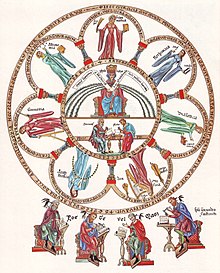
In the 12th century the iconic prototype – Philosophia et septem artes liberales (Philosophy and seven liberal arts) – was produced by an Alsatian nun and abbess Herrad of Landsberg with her community of women equally office of the Hortus deliciarum .[18] Their encyclopedia compiled ideas drawn from philosophy, theology, literature, music, arts, and sciences and was intended as a education tool for women of the abbey.[19] Compiled between 1167 and 1185 information technology contained humanity's most pregnant ideas. The epitome Philosophy and seven liberal arts represents the circle of philosophy, and is presented equally a rosette of a cathedral: a central circle and a series of semicircles arranged all effectually. Information technology shows learning and noesis organised into seven relations, the Septem Artes Liberales or Seven Liberal Arts. Each of these arts find their source in the Greek φιλοσοφία, philosophia, literally "love of wisdom".[18] St. Albert the Bang-up, a doctor of the Catholic Church building, asserted that the 7 liberal arts were referred to in Sacred Scripture, saying: "It is written, 'Wisdom hath congenital herself a firm, she hath hewn her out seven pillars' (Proverbs nine:1). This house is the Blessed Virgin; the 7 pillars are the seven liberal arts."[20]

In the Renaissance, the Italian humanists and their Northern counterparts, despite in many respects continuing the traditions of the Middle Ages, reversed that process.[21] Re-christening the former trivium with a new and more aggressive proper noun: Studia humanitatis , and also increasing its scope, they downplayed logic as opposed to the traditional Latin grammar and rhetoric, and added to them history, Greek, and moral philosophy (ethics), with a new emphasis on poetry as well.[22] The educational curriculum of humanism spread throughout Europe during the sixteenth century and became the educational foundation for the schooling of European elites, the functionaries of political administration, the clergy of the various legally recognized churches, and the learned professions of law and medicine.[23] The ideal of a liberal arts, or humanistic education grounded in classical languages and literature, persisted in Europe until the centre of the twentieth century; in the The states, information technology had come under increasingly successful attack in the tardily 19th century past academics interested in reshaping American higher education around the natural and social sciences.[24] [25]
Similarly, Wilhelm von Humboldt's educational model in Prussia (at present Germany), which later became the office model for higher pedagogy besides in N America, went beyond vocational grooming. In a letter to the Prussian king, he wrote:
There are undeniably certain kinds of knowledge that must exist of a general nature and, more importantly, a certain tillage of the mind and grapheme that nobody can afford to exist without. People obviously cannot be good craftworkers, merchants, soldiers or businessmen unless, regardless of their occupation, they are good, upstanding and – according to their status – well-informed human beings and citizens. If this footing is laid through schooling, vocational skills are easily acquired later on, and a person is e'er gratis to motion from i occupation to another, equally and so often happens in life.[26]
The philosopher Julian Nida-Rümelin has criticized discrepancies between Humboldt'south ethics and the contemporary European education policy, which narrowly understands education as a preparation for the labor marketplace, arguing that we need to decide between "McKinsey and Humboldt".[27]
Modern usage [edit]
The modernistic use of the term liberal arts consists of 4 areas: the natural sciences, social sciences, arts, and humanities. Bookish areas that are associated with the term liberal arts include:
- Life sciences (biology, environmental, neuroscience)
- Concrete science (physics, astronomy, chemistry, physical geography)
- Logic, mathematics, statistics, reckoner science
- Philosophy
- History
- Social scientific discipline (anthropology, economics, human geography, linguistics, political scientific discipline, jurisprudence, psychology, and sociology)
- Creative arts (fine arts, music, performing arts, literature)
For example, the cadre courses for Georgetown University'south Medico of Liberal Studies programme[28] cover philosophy, theology, history, fine art, literature, and the social sciences. Wesleyan Academy'southward Principal of Arts in Liberal Studies program includes courses in visual arts, art history, artistic and professional writing, literature, history, mathematics, film, government, pedagogy, biological science, psychology, and astronomy.[29]
Secondary school [edit]
Liberal arts educational activity at the secondary school level prepares students for higher education at a university.[ citation needed ]
Curricula differ from school to school, but by and large include language, chemical science, biology, geography, fine art, music, history, philosophy, civics, social sciences, and foreign languages.[ citation needed ]
In the United States [edit]
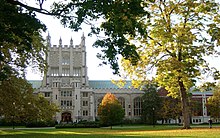
In the United States, liberal arts colleges are schools emphasizing undergraduate study in the liberal arts.[30] The teaching at liberal arts colleges is ofttimes Socratic, typically with small classes; professors are oft allowed to concentrate more on their teaching responsibilities than are professors at enquiry universities.[ citation needed ]
In add-on, most four-twelvemonth colleges are not devoted exclusively or primarily to liberal arts degrees, but offer a liberal arts degree, and let students non majoring in liberal arts to have courses to satisfy distribution requirements in liberal arts.[ citation needed ]
Traditionally, a bachelor'due south degree in one particular area within liberal arts, with substantial report exterior that main area, is earned over four years of total-time written report. However, some universities such equally Saint Leo Academy,[31] Pennsylvania State University,[32] Florida Institute of Applied science,[33] and New England College[34] have begun to offering an associate caste in liberal arts. Colleges like the Thomas More Higher of Liberal Arts offer a unique program with only 1 caste offer, a Bachelor of Arts in Liberal Studies, while the Harvard Extension School offers both a Available of Liberal Arts and a Chief of Liberal Arts.[35] Additionally, colleges like the Academy of Oklahoma College of Liberal Studies and the Harvard Extension School[36] offering an online, part-time selection for adult and nontraditional students.[ commendation needed ]
Nigh students earn either a Bachelor of Arts degree or a Bachelor of Science[37] degree; on completing undergraduate study, students might progress to either a liberal arts graduate school or a professional schoolhouse (public assistants, engineering, business, law, medicine, theology).[ citation needed ]
Cracking Books motility [edit]
In 1937 St. John'southward Higher inverse its curriculum to focus on the Great Books of the Western Earth to provide a new sort of education that separated itself from the increasingly specialized nature of higher schooling.[38]
![[icon]](https://upload.wikimedia.org/wikipedia/commons/thumb/1/1c/Wiki_letter_w_cropped.svg/20px-Wiki_letter_w_cropped.svg.png) | This section needs expansion. You tin assistance by adding to it. (July 2021) |
In Europe [edit]

"Thriumph of Due south. Tomas & Allegory of the Sciences" by Andrea di Bonaluto. Frasco, 1365-68, Basilica di S. Maria Novella.
In most parts of Europe, liberal arts education is deeply rooted. In Federal republic of germany, Austria and countries influenced by their education arrangement information technology is called 'humanistische Bildung' (humanistic education). The term is not to be dislocated with some modern educational concepts that use a similar wording. Educational institutions that see themselves in that tradition are ofttimes a Gymnasium (high school, grammar school). They aim at providing their pupils with comprehensive education (Bildung) to form personality with regard to a pupil's own humanity as well as their innate intellectual skills.[ commendation needed ] Going back to the long tradition of the liberal arts in Europe, pedagogy in the higher up sense was freed from scholastic thinking and re-shaped by the theorists of the Enlightenment; in particular, Wilhelm von Humboldt. Since students are considered to have received a comprehensive liberal arts instruction at gymnasia, very often the role of liberal arts instruction in undergraduate programs at universities is reduced compared to the US educational organisation.[ commendation needed ] Students are expected to use their skills received at the gymnasium to farther develop their personality in their own responsibility, e.g. in universities' music clubs, theatre groups, language clubs, etc. Universities encourage students to do so and offer respective opportunities but do non make such activities part of the university's curriculum.[ citation needed ]
Thus, on the level of higher education, despite the European origin of the liberal arts college,[39] the term liberal arts college normally denotes liberal arts colleges in the United States.[ citation needed ] With the exception of pioneering institutions such as Franklin Academy Switzerland (formerly known as Franklin College), established as a Europe-based, US-way liberal arts college in 1969,[40] merely recently some efforts have been undertaken to systematically "re-import" liberal arts didactics to continental Europe, as with Leiden University College The Hague, University College Utrecht, University College Maastricht, Amsterdam University Higher, Roosevelt Academy (now University College Roosevelt), University College Twente (ATLAS), Erasmus University College, the University of Groningen, Bratislava International School of Liberal Arts, Leuphana University of Lüneburg, Central European University, and Bard College Berlin, formerly known every bit the European College of Liberal Arts. Fundamental European University launched a liberal arts undergraduate degree in Culture, Politics, and Society [41] in 2020 equally office of its movement to Vienna and accreditation in Austria. Besides as the colleges listed above, some universities in the Netherlands offer bachelors programs in Liberal Arts and Sciences (Tilburg University). Liberal arts (as a degree program) is simply get-go to institute itself in Europe. For example, Academy Higher Dublin offers the degree, equally does St. Marys University Higher Belfast, both institutions coincidentally on the island of Ireland. In the netherlands, universities have opened constituent liberal arts colleges under the terminology university college since the late 1990s. The four-year bachelor's degree in Liberal Arts and Sciences at University College Freiburg is the first of its kind in Germany. It started in October 2012 with 78 students.[42] The first Liberal Arts caste program in Sweden was established at Gothenburg Academy in 2011,[43] followed by a Liberal Arts Bachelor Programme at Uppsala University's Campus Gotland in the autumn of 2013.[44] The first Liberal Arts program in Georgia was introduced in 2005 by American-Georgian Initiative for Liberal Pedagogy (AGILE),[45] an NGO. Cheers to their collaboration, Ilia Country University[46] became the first higher education institution in Georgia to establish a liberal arts plan.[47]
In France, Chavagnes Studium, a Liberal Arts Report Eye in partnership with the Institut Catholique d'études supérieures, and based in a sometime Cosmic seminary, is launching a ii-year intensive BA in the Liberal Arts, with a distinctively Cosmic outlook.[48] Information technology has been suggested that the liberal arts degree may become part of mainstream education provision in the United Kingdom, Ireland and other European countries. In 1999, the European College of Liberal Arts (at present Bard College Berlin) was founded in Berlin[49] and in 2009 information technology introduced a 4-year Bachelor of Arts programme in Value Studies taught in English,[50] leading to an interdisciplinary degree in the humanities.[ commendation needed ]
In England, the first institution[51] to retrieve and update a liberal arts teaching at the undergraduate level was the University of Winchester with their BA (Hons) Mod Liberal Arts programme which launched in 2010.[51] In 2012, University College London began its interdisciplinary Arts and Sciences BASc degree (which has kinship with the liberal arts model) with eighty students.[52] King's College London launched the BA Liberal Arts, which has a slant towards arts, humanities and social sciences subjects.[53] The New College of the Humanities besides launched a new liberal education programme. Durham University has both a pop BA Liberal Arts and a BA Combined Honours in Social Sciences programme, both of which allow for interdisciplinary approaches to education. The University of Nottingham also has a Liberal Arts BA with study abroad options and links with its Natural Sciences degrees.[54] In 2016, the University of Warwick launched a three/four-year liberal arts BA degree, which focuses on transdisciplinary approaches and trouble-based learning techniques in addition to providing structured disciplinary pathways.[55] And for 2017 entry UCAS lists 20 providers of liberal arts programmes.[56]
In Scotland, the four-yr undergraduate Honours degree, specifically the Chief of Arts, has historically demonstrated considerable breadth in focus. In the first two years of Scottish MA and BA degrees students typically study a number of different subjects earlier specialising in their Honours years (third and 4th year). The University of Dundee and the University of Glasgow (at its Crichton Campus) are the only Scottish universities that currently offer a specifically named 'Liberal Arts' caste.[ citation needed ]
In Slovakia, the Bratislava International School of Liberal Arts (BISLA) is located in the Old Town of Bratislava. It is the kickoff liberal arts college in Key Europe. A individual, accredited 3-yr caste-granting undergraduate institution, it opened in September 2006.[ commendation needed ]
In Asia [edit]

"A immature man introduced to the seven Liberal Arts" past Sandro Boticelli, c. 1484. Fresco in Villa Lemni, Florence.
The Commission on Higher Education of the Philippines mandates a General Education curriculum required of all college teaching institutions; it includes a number of liberal arts subjects, including history, art appreciation, and ethics, plus interdisciplinary electives. Many universities have much more robust liberal arts core curricula; most notably, the Jesuit universities such as Ateneo de Manila University accept a strong liberal arts core curriculum that includes philosophy, theology, literature, history, and the social sciences. Forman Christian College is a liberal arts university in Lahore, Pakistan. It is 1 of the oldest institutions in the Indian subcontinent. It is a chartered university recognized by the Higher Education Commission of Pakistan. Habib Academy in Karachi, Pakistan offers a holistic liberal arts and sciences experience to its students through its uniquely tailored liberal core program which is compulsory for all undergraduate caste students.[57] [58] The Underwood International College of Yonsei University, Korea, has compulsory liberal arts courses for all the student torso.[ commendation needed ]
In Bharat, in that location are many institutions that offer undergraduate UG or bachelor's degree/diploma and postgraduate PG or master'southward degree/diploma equally well as doctoral PhD and postdoctoral studies and research, in this academic discipline. Manipal Academy of Higher Education – MAHE, an Institution of Eminence as recognised by MHRD of Govt of India in 2018, houses a Kinesthesia of Liberal Arts, Humanities and Social Sciences, and also others like Symbiosis & FLAME University in Pune, Ahmedabad University, Ashoka University, and Azim Premji Academy in Bangalore. Lingnan University and University of Liberal Arts- People's republic of bangladesh (ULAB) are also a few such liberal arts colleges in Asia. International Christian Academy in Tokyo is the first and one of the very few liberal arts universities in Japan. Fulbright Academy Vietnam is the first liberal arts establishment in Vietnam.[ citation needed ]
In Commonwealth of australia [edit]
Campion College is a Roman Catholic dedicated liberal arts college, located in the western suburbs of Sydney. Founded in 2006, it is the first third educational liberal arts college of its type in Australia. Campion offers a Bachelor of Arts in the Liberal Arts every bit its sole undergraduate degree. The key disciplines studied are history, literature, philosophy, and theology.[59]
The Millis Institute is the Schoolhouse of Liberal Arts at Christian Heritage College located in Brisbane. Founded by Dr. Ryan Messmore, former President of Campion College, the Millis Institute offers a Bachelor of Arts in the Liberal Arts in which students can choose to major in Philosophy, Theology, History or Literature. It also endorses a 'Study Abroad' program whereby students can earn credit towards their degree by undertaking two units over a v-week programme at the University of Oxford. As of 2022, Elizabeth Hillman is currently the President of the Millis Institute.[60]
A new school of Liberal Arts has been formed in the University of Wollongong; the new Arts grade entitled 'Western Civilisation' was first offered in 2020. The interdisciplinary curriculum focuses on the archetype intellectual and creative literature of the Western tradition. Courses in the liberal arts have recently been developed at the University of Sydney and the University of Notre Dame.[ citation needed ]
Come across too [edit]
- Artes Mechanicae – Latin for "the mechanical arts"
- Bachelor of Full general Studies
- Bachelor of Liberal Arts
- Bachelor of Liberal Studies
- Classical education
- Classical education motion
- College of Arts and Sciences
- Physician of Liberal Studies
- Education in aboriginal Greece
- Education in aboriginal Rome
- Teaching reform § Reforms of classical education
- Four arts
- General studies
- Not bad books
- Great Books programs in Canada
- Humanitas
- Humanities
- Interdisciplinarity
- Jesuit education (Eloquentia perfecta)
- Liberal arts college
- Liberal instruction
- List of liberal arts colleges
- STEAM fields
- Transcendentalism
Citations [edit]
- ^ "MA Liberal Arts | Form Overview". University of Winchester . Retrieved 6 Feb 2022.
- ^ "What is Liberal Arts? – Aboriginal, Medieval, Modernistic". Liberal Arts U.k. . Retrieved 4 June 2018.
- ^ Kimball, Bruce A., 1951- (1995). Orators & philosophers : a history of the idea of liberal didactics (Expanded ed.). New York: College Entrance Examination Lath. ISBN0-87447-514-7. OCLC 32776486.
{{cite book}}: CS1 maint: multiple names: authors list (link) - ^ Tubbs, Nigel (2014). Philosophy and Modern Liberal Arts Didactics: Freedom is to Learn. Houndmills, Basingstoke, Hampshire: Palgrave Macmillan. p. 1. ISBN978-1-137-35891-2. OCLC 882530818.
- ^ Tubbs, Nigel (2014). Philosophy and Modern Liberal Arts Pedagogy: Freedom is to Learn. Houndmills, Basingstoke, Hampshire: Palgrave Macmillan. p. 17. ISBN978-ane-137-35891-2. OCLC 882530818.
- ^ "Trivium and Quadrivium | The Vii Liberal Arts | Study Liberal Arts". Liberal Arts . Retrieved 25 April 2020.
- ^ "Philosophy and the Liberal Arts | Essays". Liberal Arts. 25 January 2020. Retrieved 25 April 2020.
- ^ Curtius, Ernst Robert (1973) [1948]. European Literature and the Latin Heart Ages . Translated by Trask, Willard R. Princeton: Princeton University Press. p. 37. ISBN9780691097398.
The classical sources include Cicero, De Oratore, I.72–73, III.127, and De re publica, I.30.
- ^ Castle, E.B. (1969). Ancient Educational activity and Today. p. 59.
- ^ Kimball, Bruce. Orators and Philosophers. New York: College Entrance Examination Lath, 1995. p. 13
- ^ Cicero. De Inventione. Book 1, Section 35
- ^ Seneca. Ben Schneider (ed.). "Epistle". Stoics.com. 88. Retrieved 26 Baronial 2013.
- ^ a b Lausberg, H. (1998). Handbook of Literary Rhetoric. p. 10.
- ^ Waddell, Helen (1968). The Wandering Scholars. p. 25.
- ^ "James Burke: The Day the Universe Changed In the Light Of the To a higher place". YouTube. Archived from the original on 23 May 2012.
- ^ Wagner, David Leslie (1983). The Seven liberal arts in the Middle Ages. Indiana Academy Press. ISBN978-0-253-35185-2 . Retrieved 5 January 2013.
- ^ Waddell, Helen (1968). The Wandering Scholars. pp. 141–143.
- ^ a b Tidbury, Iain (5 August 2019). "Liberal Arts Educational activity by and for Women". Liberal Arts . Retrieved 5 August 2019.
- ^ Griffiths, Fiona J. (3 June 2011). The Garden of Delights: Reform and Renaissance for Women in the Twelfth Century. University of Pennsylvania Press. ISBN9780812202113.
- ^ Michael, William (2020). "The Virgin Mary and the Classical Liberal Arts". Classical Liberal Arts University.
- ^ G. Norton ed., The Cambridge History of Literary Criticism Vol 3 (1999)p. 46 and pp. 601–4
- ^ Paul Oskar Kristeller, Renaissance Thought II: Papers on Humanism and the Arts (New York: Harper Torchbooks, 1965), p. 178.
- ^ Charles G. Nauert, Humanism and the Civilization of Renaissance Europe (New Approaches to European History) (Cambridge University Printing, 2006), pp. 172–173.
- ^ Bod, Rens; A New History of the Humanities, Oxford University Press, Oxford, 2014.
- ^ Adler, Eric; The Battle of the Classics: How a Nineteenth-Century Debate Can Save the Humanities Today, Oxford University Printing, Oxford, 2020, p. 59.
- ^ As quoted in Profiles of educators: Wilhelm von Humboldt (1767–1835) by Karl-Heinz Günther (1988), doi:x.1007/BF02192965
- ^ Nida-Rümelin, Julian (29 October 2009). "Bologna-Prozess: Dice Chance zum Kompromiss ist da". Dice Zeit (in German). Retrieved 29 November 2015.
- ^ "curriculum". Georgetown University Doctor of Liberal Studies.
- ^ "Graduate Liberal Studies". Wesleyan University (www.wesleyan.edu).
- ^ "Defining Liberal Arts Education" (PDF). Wabash College. Archived from the original (PDF) on 21 Oct 2012. Retrieved 9 Dec 2012.
- ^ "Online Liberal Arts Acquaintance Degree". Saint Leo University. Archived from the original on sixteen Baronial 2013. Retrieved 26 August 2013.
- ^ "Online Associate in Arts in Messages, Arts, and Sciences | Overview". Penn Country University. Retrieved 26 Baronial 2013.
- ^ "Associate'southward Degree in Liberal Arts – Liberal Arts Caste Online". Florida Institute of Technology. Retrieved 26 August 2013.
- ^ "Assembly in Liberal Studies". New England College.
- ^ https://extension.harvard.edu.
- ^ https://extension.harvard.edu.
- ^ For instance, Georgia Establish of Applied science's available of science degree in Practical Languages and Intercultural Studies http://world wide web.modlangs.gatech.edu
- ^ "History - Liberal Arts College - Bang-up Books | St. John's College". world wide web.sjc.edu . Retrieved 20 March 2021.
- ^ Harriman, Philip L. (1935). "Antecedents of the Liberal-Arts College". The Journal of Higher Pedagogy. Ohio Land University Press. 6 (2): 63–71. doi:10.2307/1975506. ISSN 1538-4640. JSTOR 1975506.
- ^ "About Franklin". Franklin Academy Switzerland Official Spider web Site. Franklin Academy Switzerland. Archived from the original on 8 April 2014. Retrieved 3 July 2014.
- ^ https://world wide web.bachelorsportal.com/universities/79/primal-european-academy.html.
- ^ "Liberal Arts and Sciences Program (LAS)". University College Freiburg. Archived from the original on 20 August 2013. Retrieved 26 August 2013.
- ^ "Liberal Arts, Gothenburg University". Flov.gu.se. 22 May 2013. Retrieved 26 Baronial 2013.
- ^ "Liberal Arts Programme at Uppsala University". Archived from the original on thirty June 2017. Retrieved 29 April 2018.
- ^ "Agile". Agile.ge. Archived from the original on 6 October 2013. Retrieved 26 August 2013.
- ^ "ილიაუნი -მთავარი". Iliauni.edu.ge. Retrieved 26 August 2013.
- ^ "Bachelor Degree". Iliauni. Retrieved 26 August 2013.
- ^ "The Chavagnes Studium – Catholic Liberal Arts Centre". Chavagnes.org. 10 March 2018. Retrieved 20 September 2018.
- ^ "Berlin'due south sturdiest ivory tower". Expatica.com. Retrieved 26 August 2013.
- ^ "GERMANY: New arroyo to liberal studies". Universityworldnews.com. 15 March 2009. Retrieved 26 August 2013.
- ^ a b "It'south the breadth that matters". 23 December 2010. Retrieved 13 September 2016.
- ^ "Arts and Sciences (BASc) programmes". University College London. Retrieved 26 August 2013.
- ^ "KCL – About Liberal Arts". Retrieved xv January 2014.
- ^ "Liberal Arts programme – BA Hons Y002". University of Nottingham. Retrieved iv April 2018.
- ^ "Liberal Arts". University of Warwick.
- ^ "UCAS Search tool – Venue Results". search.ucas.com . Retrieved 13 September 2016.
- ^ "Archived copy". www.newslinemagazine.com. Archived from the original on x Feb 2015. Retrieved 2 February 2022.
{{cite web}}: CS1 maint: archived copy every bit title (link) - ^ Marylou Andrew (2015). "Liberal to the core". Aurora. Archived from the original on ii April 2015. Retrieved 24 March 2015.
- ^ "Liberal Arts Instruction". Campion College . Retrieved 12 February 2021.
- ^ "Office of the President | Mills College".
References [edit]
- Castle, Eastward.B. (1969). Ancient Education and Today.
- Curtius, Ernst Robert (1973) [1948]. European Literature and the Latin Middle Ages . Translated by Trask, Willard R. Princeton: Princeton University Press. ISBN9780691097398.
- Griffiths, Fiona J. (2011). The Garden of Delights: Reform and Renaissance for Women in the Twelfth Century. University of Pennsylvania Printing. ISBN9780812202113.
- Kimball, Bruce A. Orators and Philosophers: A History of the Idea of Liberal Educational activity. College Board, 1995.
- Lausberg, H. (1998). Handbook of Literary Rhetoric.
- Michael, William (2020). "The Virgin Mary and the Classical Liberal Arts". Classical Liberal Arts Academy.
- Tidbury, Iain (5 August 2019). "Liberal Arts Education by and for Women". Liberal Arts . Retrieved 5 August 2019.
- Tubbs, Nigel (2014). Philosophy and Mod Liberal Arts Teaching: Freedom is to Learn. Houndmills, Basingstoke, Hampshire: Palgrave Macmillan. ISBN978-1-137-35891-two. OCLC 882530818.
- Waddell, Helen (1968). The Wandering Scholars.
- Wagner, David Leslie (1983). The Vii liberal arts in the Middle Ages. Indiana University Press. ISBN978-0-253-35185-2.
Further reading [edit]
- Anders, George (2019). You lot Can Do Anything: The Surprising Power of a "Useless" Liberal Arts Teaching. Back Bay Books. ISBN978-0316548885.
- Barzun, Jacques. The House of Intellect, Reprint Harper Perennial, 2002.
- Blaich, Charles, Anne Bost, Ed Chan, and Richard Lynch. "Defining Liberal Arts Didactics." Center of Enquiry in the Liberal Arts, 2004.
- Blanshard, Brand. The Uses of a Liberal Education: And Other Talks to Students. (Open up Court, 1973. ISBN 0-8126-9429-v)
- Friedlander, Jack. Measuring the Benefits of Liberal Arts Education in Washington's Community Colleges. Los Angeles: Center for the Written report of Community Colleges, 1982a. (ED 217 918)
- Grafton Anthony and Lisa Jardine. From Humanism to the Humanities: The Institutionalizing of the Liberal Arts in Fifteenth- and Sixteenth-century Europe, Harvard University Printing, 1987.
- Guitton, Jean. A Student's Guide to Intellectual Work, The Academy of Notre Dame Printing, 1964.
- Highet, Gilbert. The Fine art of Didactics, Vintage Books, 1950.
- Joseph, Sis Miriam. The Trivium: The Liberal Arts of Logic, Grammar, and Rhetoric. Paul Dry out Books Inc, 2002.
- Kimball, Bruce A. The Liberal Arts Tradition: A Documentary History. University Press Of America, 2010.
- T. Kaori Kitao; William R. Kenan, Jr. (27 March 1999). The Usefulness Of Uselessness (PDF). Keynote Address, The 1999 Institute for the Bookish Advancement of Youth's Odyssey at Swarthmore College. Archived from the original (PDF) on ii October 2008.
{{cite book}}: CS1 maint: location (link) - McGrath, Charles. "What Every Student Should Know", New York Times, 8 January 2006.
- Parker, H. "The 7 Liberal Arts," The English Historical Review, Vol. 5, 1890.
- Pfnister, Allan O. (1984). "The Role of the Liberal Arts Higher: A Historical Overview of the Debates". The Journal of College Educational activity. Ohio State University Printing. 55 (ii): 145–seventy. doi:ten.2307/1981183. ISSN 1538-4640. JSTOR 1981183.
- Reeves, Floyd W. (1930). "The Liberal-Arts College". The Periodical of Higher Teaching. Ohio State Academy Press. 1 (7): 373–fourscore. doi:10.2307/1974170. ISSN 1538-4640. JSTOR 1974170.
- Ruckdeschel, Christopher. On the Nature of the Classical Liberal Arts, Bookbaby, 2019.
- Saint-Victor, Hugh of. The Didascalicon, Columbia Academy Press, 1961.
- Schall, James V. Another Sort of Learning, Ignatius Press, 1988.
- Seidel, George J. (1968). "Saving the Small College". The Periodical of Higher Educational activity. Ohio Land University Printing. 39 (half dozen): 339–42. doi:10.2307/1979916. ISSN 1538-4640. JSTOR 1979916.
- Sertillanges, A. Thousand. The Intellectual Life, The Cosmic University of America Press, 1998.
- Tubbs, Due north. (2011) "Know Thyself: Macrocosm and Microcosm" in Studies in Philosophy and Teaching Volume xxx no.1
- Winterer, Caroline. The Culture of Classicism: Ancient Hellenic republic and Rome in American Intellectual Life, 1780–1910. Baltimore: Johns Hopkins Academy Press, 2002.
- Wriston, Henry M. The Nature of a Liberal College. Lawrence Academy Press, 1937.
- Zakaria, Fareed. In Defense of a Liberal Education. New York: W.W. Norton & Company, 2015.
External links [edit]
- . New International Encyclopedia. 1905. Definition and brusk history of the Seven Liberal Arts from 1905.
- Fr. Herve de la Bout, "The Seven Liberal Arts", Edocere, a Resources for Catholic Pedagogy, February 2002. Thomas Aquinas's definition of and justification for a liberal arts education.
- Otto Willmann. "The Seven Liberal Arts". In The Catholic Encyclopedia. New York: Robert Appleton Company, 1907. Retrieved xiii August 2012.] "[Renaissance] Humanists, over-addicted of change, unjustly condemned the organisation of the 7 liberal arts as fell. It is no more than savage than the Gothic style, a name intended to be a reproach. The Gothic, built upwardly on the formulation of the sometime basilica, ancient in origin, all the same Christian in character, was misjudged by the Renaissance on account of some excrescences, and obscured by the additions engrafted upon it past mod lack of taste… That the achievements of our forefathers should be understood, recognized, and adapted to our ain needs, is surely to be desired."
- Andrew Chrucky (one September 2003). "The Aim of Liberal Educational activity". "The content of a liberal education should be moral problems equally provided by history, anthropology, folklore, economics, and politics. And these should be discussed along with a reflection on the nature of morality and the nature of discussions, i.e., through a study of rhetoric and logic. Since discussion takes place in linguistic communication, an attempt should be made to develop a facility with language."
- "Philosophy of Liberal Education" A bibliography, compiled by Andrew Chrucky, with links to essays offering different points of view on the pregnant of a liberal teaching.
- Mark Peltz, "The Liberal Arts and Leadership", College News (The Annapolis Group), xiv May 2012. A defense of liberal education by the Acquaintance Dean of Grinnell Higher (get-go appeared in Inside Higher Ed).
- "Liberal Arts at the Community Higher", an ERIC Fact Sheet. ERIC Clearinghouse for Junior Colleges Los Angeles
- "A Descriptive Assay of the Customs College Liberal Arts Curriculum". ERIC Clearinghouse for Inferior Colleges Los Angeles
- The Center of Inquiry in the Liberal Arts. Website about The Wabash Report (for improving liberal education). Sponsored by the Centre of Research in the Liberal Arts at Wabash Higher (Indiana), the Wabash Study began in the fall of 2010 – scheduled to end in 2013. Participants include 29 prominent colleges and universities.
- Academic Commons. An online platform in support of the liberal education community. It is a forum for sharing practices, outcomes, and lessons learned of online learning. Formerly sponsored by the Center of Inquiry in the Liberal Arts, The Academic Commons is hosted by the National Institute for Engineering science in Liberal Educational activity ("NITLE".).
- The Liberal Arts Advantage – for Business. Website dedicated to "Bridging the gap between business and the liberal arts". "A liberal arts education is aimed at developing the ability to think, reason, clarify, decide, discern, and evaluate. That's in contrast to a professional person or technical education (business, engineering, computer science, etc.) which develops specific abilities aimed at preparing students for vocations."
- Video explanation by Professor Nigel Tubbs of liberal arts curriculum and degree requirements of Winchester University, UK.. "Liberal arts education (Latin: liberalis, free, and ars, art or principled practice) involves us in thinking philosophically across many bailiwick boundaries in the humanities, the social and natural sciences, and fine arts. The caste combines compulsory modules covering fine art, faith, literature, scientific discipline and the history of ideas with a broad range of optional modules. This enables students to accept flexibility and control over their programme of study and the content of their assessments."
Source: https://en.wikipedia.org/wiki/Liberal_arts_education
0 Response to "In a Class of 30 Students 18 Are Liberal Arts Majors If a Stident Is Selected at Random"
Post a Comment